The Hill They Chose
Nobody Who Voted for HB 381 Will Say the Process Failed. Watch What They Do Instead.

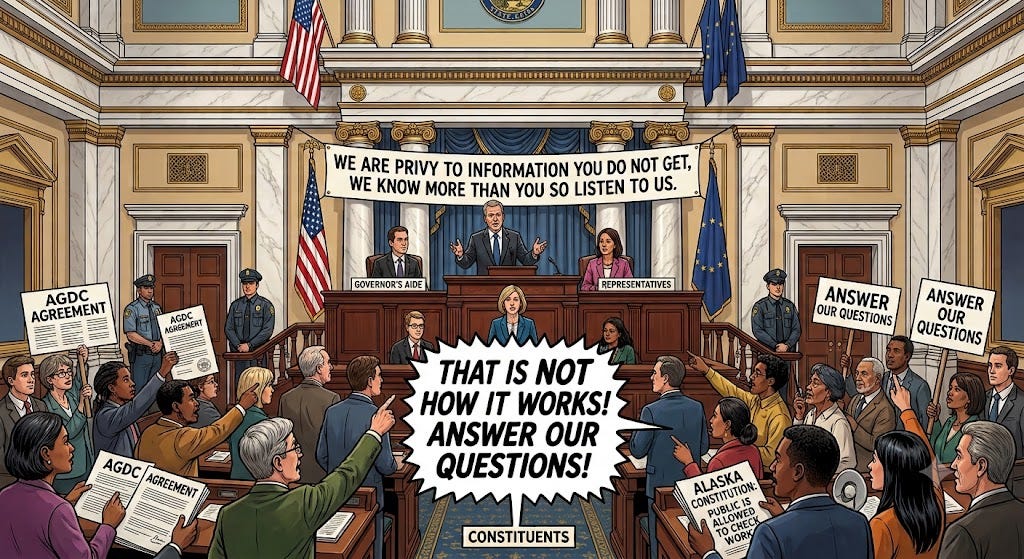
There is a posture running through this entire debate that deserves to be named for what it is. It shows up every time a constituent asks a specific, sourced, answerable question about HB 381 and gets back, instead of an answer, some version of the same message: you do not have access to what we have access to, so trust the people who do. That posture is not accountability. It is a claim to a kind of standing the Alaska Constitution does not actually grant anyone in Juneau. Legislators are not a privileged class entitled to know more than the people who elected them and to be believed simply because they say they know more. They work for the public, and the public is allowed to check their work.
What makes this year different is that the public has now checked the work, repeatedly, and every time the answer has come back the same way: the people claiming superior knowledge either did not understand what they were supposedly privy to, or understood it and chose not to say so. Either way, the claim to special standing does not survive contact with what actually happened in committee rooms, on leaked documents, and in their own published writing this year.
The Leak Nobody Wanted Answered
A handful of state senators obtained a leaked draft of AGDC’s own internal analysis of its confidential agreement with Glenfarne, showing a clawback mechanism that could require the state to pay Glenfarne to retake the project, the exact scenario Glenfarne’s own president had told the Senate Finance Committee, under direct questioning, could never happen. One senator’s response after reading it: “We don’t think this document supports that statement.” Another’s was sharper: if Glenfarne later invoked a provision it had repeatedly denied existed, “I think we might have an argument in fraud.”
Watch what happened next, because it is the clearest version of the posture this piece is about. AGDC’s president opened an investigation, not into whether the public testimony had been accurate, but into how the document got out, and told reporters the lesson AGDC would take from it is “consideration on when they want to share information with us.” Less disclosure, not more, was the stated response to getting caught having disclosed too little. Days later, an AGDC board member compared the legislators asking questions to mosquitoes, “irritating, relentless, and somehow always present,” and said he hoped the conference committee would “stop hovering.” One senator called it “outrageously demeaning.” One House member named exactly what was happening: “Maybe the thought that the Legislature is annoying is true. Because the truth sure seems to be inconvenient.”
A prominent conservative commentary site completed the pattern from the outside. Its piece on the leak is built around the word “stolen,” not leaked, and spends real space questioning whether the senators who saw the document, several of whom are attorneys, had some professional obligation not to look. It cites a year-old hearing where Glenfarne’s consultant denied the state could end up paying, but that denial only holds up if you accept a technical distinction between paying nothing and paying compensation for value added, the same kind of word game running through nearly every defense in this piece. Months earlier, before any of this had leaked, one Republican legislator had already made the mirror-image argument, that simply requiring more financial disclosure would “have a chilling effect on investment.” Before the information existed publicly, asking for it was the danger. After it existed publicly, having let it out was the danger. The content was never the actual subject either time.
The Legislator Who Won’t Debate the Mechanism, Only the Word
Rep. Kevin McCabe published a piece in May arguing that legislators no longer owe a serious answer to constituents who use AI to help research and write. He lists the “tells” of AI-assisted writing, confident statute citations, dollar figures, a particular sentence construction, and concludes that what looks like a serious argument is often “a machine-generated political manifesto,” not real constituent engagement deserving of a real response.
Here is the part worth sitting with. Three months earlier, in a private exchange, McCabe wrote in his own words that Glenfarne would not be here without the ability to sequester CO2 on the slope, and that Japan would not buy Alaska’s gas without CCUS. Three months later, in a public Substack post, he wrote that critics’ estimate of the resulting credits, roughly $7 billion, was directionally right, and added: “Remove 45Q, and I do not believe a gas line that has struggled for more than a decade gets financed.” The same legislator who argues AI-assisted constituents don’t deserve a substantive response has, on his own platform, already conceded the substance those constituents were asking him to confirm. He is not refusing to engage because the underlying claim is wrong. He is refusing to engage with the form of the question while admitting the answer somewhere else.
He is not refusing to engage because the underlying claim is wrong. He is refusing to engage with the form of the question while admitting the answer somewhere else.
“We’re Not Giving Them a Handout”, Tested in Real Time
McCabe’s own piece on HB 381 states plainly that 45Q and 45V “aren’t hidden, they aren’t secret,” and that since Alaska “was never collecting those federal credits,” nothing was given away. An administration official made the identical claim to me directly, in a long Facebook exchange after my last piece ran: a tax credit “isn’t paid, it’s a reduction,” and when pressed, “is the federal government giving a private entity money? No.”
I laid the actual mechanism out for him five separate times, in five separate comments, each one walking through the same chain: the credit is issued, the credit is sold to a profitable third party for cash, the buyer uses it to reduce its own federal tax bill, the Treasury collects less revenue as a direct result, the seller holds the cash, and the cycle repeats every year for the life of the project. That is not a theoretical description. It is how Section 45Q has worked since the Inflation Reduction Act made the credit transferable and refundable. Five times, the response was not a rebuttal of any step in that chain. It was a restatement of the word “give,” as though the entire question turned on whether the Treasury physically mails a check rather than whether it loses revenue equal to what the seller gains in cash.
When I asked directly whether he was afraid of honesty and transparency, the answer was not an answer. It was the same word-choice objection a sixth time. Two people in this debate who present themselves as the technically informed side, a sitting legislator on House Resources and an administration official with an economics background, have now both been asked, repeatedly and specifically, to dispute the transferability mechanism itself. Neither has done it. Both substituted a vocabulary argument for an economic one, every single time.
The Legislator Who Heard the Warning and Reported the Opposite
One House supporter of the project sat in the House Finance Committee hearing on May 26 where GaffneyCline’s Nicholas Fulford told the room the project has “a narrow road to profitability” even with the full proposed tax break, that there is an unidentified tipping point past which rising costs make the project uneconomic, and that Japan’s average LNG contract price over the past decade runs below what Alaska’s gas would need to charge to hit its own profit target. A colleague in the same hearing pressed Fulford specifically on whether the headline $46.2 billion cost figure even accounts for inflation since 2018.
The next morning, that same legislator posted publicly that the hearing brought “both the promise and the reality of this project into focus,” then listed the promise side in five generic bullet points, energy security, jobs, finally monetizing stranded gas, with no mention of the narrow viability warning, the tipping point, the Japan price comparison, or the inflation question asked in the same room. Two more posts in the following weeks followed the same shape. A statement defending a no-concur vote on HB 381 never mentioned the leaked AGDC document or the clawback provisions the Senate had just added in direct response to it. A summary of House Finance public testimony cited Gulf Coast states as precedent for the AVT structure, the same claim already shown false by the actual statutes in Texas and Louisiana, neither of which has ever replaced property tax with a volumetric throughput tax. Three posts, three hearings, and in each one the specific financial substance directly available to the person writing them never makes it into what gets told to constituents.
The Graphic Someone Was Proud Of
A member of the House Resources Committee was visibly proud of a state-circulated infographic titled “HB 381 Explained,” which lists “corporate income tax” as one of five active revenue streams Alaska currently receives from this project. The Department of Revenue’s own benefit analysis shows zero corporate income tax collected from this project in every modeled year through 2062 under current law, precisely why the Senate spent weeks fighting over a pass-through entity tax provision the House later rejected. A member of the committee that has handled this bill’s substantive provisions was proud of a document asserting Alaska collects a tax it demonstrably does not collect.
What They Won’t Say
Several senators have been willing to say, plainly, that the process broke down. “We are being forced to just guess where the landmines are, guess where the pitfalls are. I don’t like being in that situation at all, and every Alaskan should be concerned about that,” one said after the leak. Another went further: “I think there’s been such distrust sown in this project that I don’t see how we can proceed forward at this point... we start over with mutual respect and mutual collaboration.” A House member named the inconvenient truth directly rather than dismiss it.
Nobody on the other side of this fight has said that yet. Not the corporation that investigated a leak instead of the claims it contradicted. Not the board member who compared elected legislators to insects. Not the commentary site that reframed a disclosure into a theft. Not the legislator who called transparency itself the danger before anyone had seen anything. Not McCabe, who dismisses AI-assisted questions on principle while privately and then publicly confirming their substance. Not the administration official who answered five direct explanations of a tax mechanism with the same word-choice objection five times. Not the House supporters who sat through warnings and reported opportunities. Not whoever was proud of a graphic asserting a fact the state’s own numbers contradict.
That is the actual hill. Not the pipeline, not the tax rate, not even the federal credits. The hill is the refusal to say, out loud, that the people asking hard questions this year were asking the right ones, and that a bill built on confidential terms, contradicted testimony, and reassurance instead of substance deserved more scrutiny before a single vote was cast, not after. Acting as though access to information confers a right to be believed without showing the work is not how representative government is supposed to function. It is how royalty used to talk to subjects. Two people who present themselves as the technically informed defenders of this project have now had every chance to refute the actual numbers and the actual mechanism in front of them. Neither has done it. What’s left, once the substance goes unanswered long enough, is not a debate. It’s a position being defended for its own sake, by people asking to be trusted simply because of the chair they sit in.
Dana Raffaniello lives in Palmer, Alaska. He works as a network engineer, reads Alaska energy legislation closely, and publishes analysis of its fiscal and structural implications at raff6482.substack.com. He is running for the Mat-Su Borough Assembly, District 2. He has no commercial interest in any energy project discussed in this analysis