There Was Never a Clean Bill
The Governor and the House Minority Keep Asking for a “Clean Gasline Bill.” Every Version They Have Produced Restructures Alaska’s Tax Code Instead.

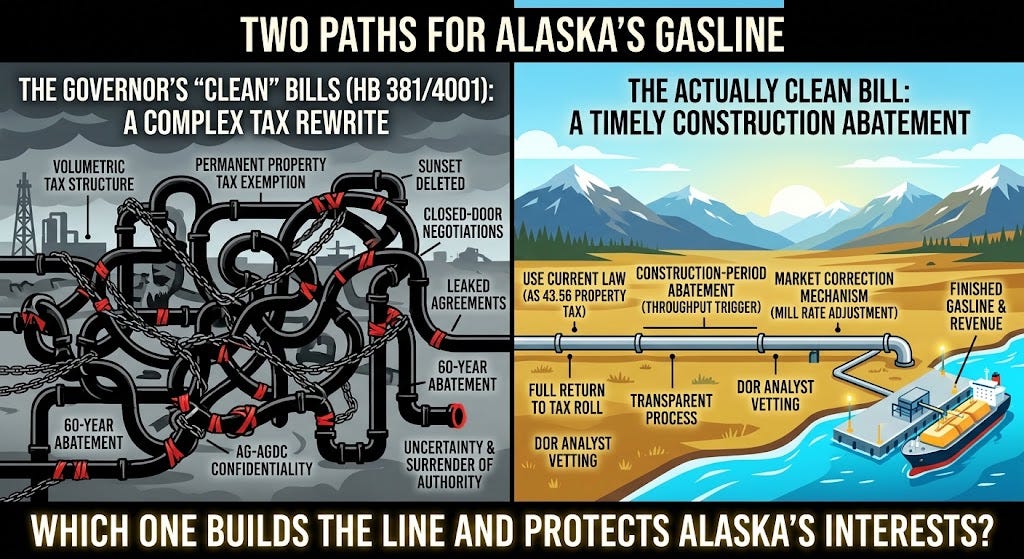
For two months, the loudest complaint from the governor’s office and the House Republican minority has been that Alaska cannot get a “clean gasline bill” passed. On July 15, the Alaska House Republican Caucus called on the Senate to place “urgent focus” on approving what it described as a clean gasline bill for the Railbelt. Rep. Justin Ruffridge, R-Soldotna, a member of the HB 381 Conference Committee, put it this way: “We cannot lose sight of why we are here. This isn’t about state government squeezing every last penny out of a pipeline that hasn’t even been built yet.” The Alaska Support Industry Alliance, the Alaska Chamber of Commerce, and the Alaska Oil and Gas Association used the identical phrase days earlier, urging lawmakers to pass “a clean version of HB 381 focused solely on advancing the Alaska LNG Project.”
Listen to that framing long enough and it starts to sound like the fight in Juneau has been between a simple pipeline bill and legislators who keep dirtying it up with unrelated taxes. That is not what has been on the table at any point since March. Every version of this legislation, from the governor’s original March 20 introduction through the House Finance committee substitute that passed 34-5 on June 12, through the Senate’s rewrite, through the conference committee product that died 19-19 on July 16, through the governor’s August 12 compromise that never received a floor vote at all, has done the same thing: eliminate Alaska’s existing 20-mill property tax authority over a $54 billion natural gas project and replace it with a fraction of that revenue under a volumetric tax structure no other American jurisdiction has ever used. That is not a pipeline bill with some tax provisions attached. That is a tax bill, full stop, and “clean” has never described anything other than which version of that tax restructuring gets voted on. When the House Republican Caucus and the industry coalition say “clean,” they mean the bill without the Senate’s added corporate income tax on pass-through entities like Hilcorp. They do not mean a bill that leaves Alaska’s property tax authority intact. No such bill has ever been introduced by anyone.
The word “clean” has done a lot of work in this debate, and almost none of it has been to describe what is actually in the bill. It has mostly functioned as a stand-in for urgency, for simplicity, for the idea that the only thing standing between Alaska and a finished pipeline is legislative cooperation. The record does not support that framing. What the record supports is a pattern, repeated across five months and two governors’ bills, in which the people asking for speed have consistently withheld the information a careful legislature would need to evaluate what it was giving up, and the two moments when Alaska got the closest look at the underlying deal came not from the bill sponsors but from a legislative committee chair who had lost confidence in the developer, and from a leaked internal memo nobody in the House ever saw.
What the Senate Chair Was Already Saying in March
Three months before the House ever voted on HB 381, Senate Resources Chair Cathy Giessel, a Republican, told reporters in a March 13 press conference: “To quote a famous movie, ‘we have a failure to communicate here.’” She said her committee did “not have confidence in Glenfarne and the limited information they are sharing,” and that lawmakers “don’t have enough of it to pass legislation they’ve been told is ‘essential’ for the project, particularly financial information.” Five days later she went further, telling reporters the project would not get the tax relief it wanted until the developer delivered more financial detail.
Giessel’s response was to introduce SB 275, the Alaska Gasline Transparency and Accountability Act, whose own sponsor statement states plainly that “key details of project agreements remain confidential, including oversight structures, financial terms and potential state revenue.” That bill existed, publicly, in the legislative record, months before the House cast a single vote on HB 381. The information gap was not a secret. It was a standing, bipartisan, on-the-record concern raised by the chair of the committee most responsible for vetting this project, and it went unresolved.
What the House Voted On June 12
The House Finance committee substitute passed 34 to 5 on June 12, a broad bipartisan vote across both caucuses. Representative Kevin McCabe, R-Big Lake, was one of the 34. The day before that vote, McCabe published a piece on his own Substack making the case for passage: “Everyone is focused on how much revenue Alaska might collect if the project gets built. Not enough people are asking what happens if it doesn’t. There is no pipeline today, no gas treatment plant, and no billion-dollar tax base sitting on the North Slope waiting to be collected. The only way any of that revenue exists is if someone actually builds the project.” He described a Facebook estimate that the property tax provisions could cost the state and local governments up to a billion dollars a year and dismissed it: “That sounds alarming until you remember that the billion dollars only exists if the project exists.”
That argument treats the relevant zero as the revenue that disappears if the project is never built. It ignores the other zero already on the record at that point: the zero percent statutory share Alaska holds in the federal 45Q and 45V credit streams that GaffneyCline’s own consultant, testifying to the Senate two weeks earlier, said were the actual driver of this project’s economics, not the gas itself. Whichever zero a member found more persuasive on June 11, neither one made it into the House floor debate the next day. Carbon capture was not named. Section 45Q was not named. Section 45V was not named. The debate concerned property tax exemption percentages, an alternative volumetric tax rate, and a price cap, and it produced a 34-5 vote on a bill whose own consultant had already testified, on the record, that none of those three things were what actually made the deal work.
What Came Out Two Weeks Later
On June 25, Alaska Beacon reported that a handful of state senators had obtained a leaked draft of AGDC’s internal “lead party decision support package,” a staff analysis prepared for the corporation’s own board, laying out the terms of its relationship with Glenfarne in more detail than had ever previously reached the legislature. The document showed that under some conditions, the state could be required to pay Glenfarne to retake control of the project if the developer failed to meet its milestones. Sen. Bill Wielechowski, D-Anchorage, said of the leak: “I don’t know how the document got out to people that it got out to, but somehow it did, and quite frankly, thank God it did.” He also said, describing the broader process: “I have not liked this process where we are working in the dark and we are not getting information that we need to protect the state’s interests. We are being forced to just guess where the landmines are, guess where the pitfalls are.”
Sen. Cathy Giessel said she found the document sitting in a pile on her desk and asked her aide to flag anything important in it. Sen. Bert Stedman said he considered releasing it publicly and did not, because it was marked confidential. All three co-chairs of the House Finance Committee told Alaska Beacon they had never seen the document at all. It was never discussed in House Finance deliberations or among members of the House majority coalition. Some Senate majority members had not seen it either. The clawback provisions it revealed inspired two Senate amendments, adopted 14-6 on party lines, requiring the developer to forfeit the project’s assets at no cost if it walked away, and requiring disclosure of any relationships with foreign companies. The House had already voted on the bill two weeks before any of that language existed.
The day after that story broke, an AGDC board member described the legislators asking these questions as “mosquitoes,” calling them “irritating, relentless, and somehow always present.” AGDC president Frank Richards, asked for comment on the remark, said only that he could “see the perspective of hearing the words that were said and their personal reaction.” That is the posture of the state’s own 25 percent owner in this project toward the branch of government constitutionally responsible for overseeing it.
Thirty Minutes
The conference committee that produced the bill’s next version consulted with Glenfarne, the Dunleavy administration, and AGDC at length. It did not consult at similar length with the House’s own 19-person Republican minority caucus. Rep. Justin Ruffridge, the minority’s representative on that committee, said he received the final copy of the bill 30 minutes before the meeting that adopted it. On the House floor, Rep. Frank Tomaszewski, R-Fairbanks, called the process “neither transparent nor collaborative.” The bill passed the Senate 11-8 on July 16. Before the House could even vote, the governor threatened a veto over the Senate’s pass-through entity tax and announced a third special session. The House then failed to adopt the conference committee report by a tie vote, 19-19.
The Closed Door in August
What followed was a two-week period in which the governor’s office negotiated directly with Glenfarne, out of public view, and produced a new bill that Alaska Beacon and other outlets began referring to as HB 4001. The governor’s own press release described the process as transmitting a compromise bill to the legislature, not introducing one, and that word choice ended up telling you everything. The bill was never formally read across the floor of either chamber. It never received a BASIS entry. It never got a committee hearing. House Speaker Bryce Edgmon and Senate President Gary Stevens both announced within a day of its release that their chambers would not reconvene to consider it. The Alaska Chamber of Commerce and a coalition of trade groups sent a letter opposing its pass-through tax provision. Hilcorp’s spokesman called the income tax language “structurally incomplete and insufficiently developed.” The House Bipartisan Majority Caucus declared the bill dead within 24 hours, noting that opposition came from “both Majority and Minority members.” Senate President Stevens, a Republican not seeking reelection, said: “I think we’ve reached the point, honestly, where we need to turn it over to the new governor, whoever that would be, and a new legislature.”
Nineteen House Republicans sent a letter asking the majority to reconvene anyway, to keep talking. Minority Leader DeLena Johnson was careful to clarify what that letter did and did not mean: “the letter doesn’t mean that all members of the minority support the governor’s bill, just that they want to continue talking about the issue and trying to find a path forward.” Even the caucus most consistently demanding a “clean” bill would not put its own name behind the one the governor actually produced.
Worse, Not Cleaner
A comparison of the bill text tells you why. The House Finance committee substitute that passed 34-5 in June allocated 50 percent of the pipeline corridor’s volumetric tax revenue to the boroughs and unorganized communities the pipeline actually passes through, a flat share that did not decline as the project matured. It gave host municipalities 93 percent of the tax collected on the gas treatment plant and LNG facilities built in their jurisdictions. And it contained a genuine sunset: a set of statutory provisions that, contingent on the same milestones required to trigger the tax structure in the first place, repealed the entire abatement and volumetric tax framework outright on January 1, 2060, returning the project to standard property taxation under Title 29 and AS 43.56 for good. That version required a capped developer payment of up to 120 million dollars into a municipal impact fund before any tax relief took effect at all.
The governor’s August compromise dropped the sunset entirely. It replaced the flat 50 percent corridor allocation with a tiered structure that pays corridor boroughs 47 percent before the LNG plant comes online and 9.5 percent afterward, precisely the period when the project generates the most value. It reduced the required upfront developer payment to 90 million dollars. Two months and one closed-door negotiation after the House’s own bipartisan vote, the deal on the table asked less of the developer and gave less to the boroughs, permanently, with no expiration date at all. If closed-door process is supposed to produce a better outcome than open committee work, this is the test case, and it failed on its own terms.
What an Actually Clean Bill Would Look Like
Here is the part nobody asking for a clean bill has proposed, and the part that answers the obvious objection that critics of HB 381 and HB 4001 never offer an alternative. Alaska already has one. It does not require inventing anything.
Start with current law, the same 20-mill property tax every other piece of oil and gas infrastructure in this state already pays, collected by the same boroughs that have always collected it. Layer a construction-period abatement on top of it, structured the same way every version of HB 381 and HB 4001 has already structured its own abatement period: no tax until the pipeline has moved a defined volume of gas for a defined stretch of time, a rolling throughput average over a set number of days. HB0381D and GH5321\A both use exactly this kind of trigger already, just pointed at a different outcome, the start of a permanent volumetric tax instead of a return to the property tax roll. The drafting is not the hard part. The legislature has already written this exact mechanism twice. It just needs to be aimed at the right destination.
That alone matches what LNG developers get everywhere else in the country. Louisiana’s Industrial Tax Exemption Program has given Cheniere’s Sabine Pass terminal, Cameron LNG, and Calcasieu Pass LNG property tax exemptions running up to ten years apiece, worth billions of dollars combined. Texas ran a similar school-district abatement program for years before it expired in 2022. Neither state rewrote its underlying property tax statute to do it. They granted a time-limited exemption under the tax code that was already on the books, and when the exemption ended, the facility went back on the same roll as everyone else. Alaska’s version does the same thing, tied to actual throughput instead of a calendar, which is arguably tighter and more defensible than the Gulf Coast standard, not looser.
If Glenfarne or its backers still want more certainty once the abatement period ends, that is a fair ask, and Alaska already has the tool for that too. The state’s oil production tax has tied its rate to a published market benchmark, the ANS crude price DOR calculates and publishes on a regular schedule, for years. Apply the same logic to gas. Have DOR select or blend an appropriate published index, Henry Hub for the domestic benchmark or the Platts JKM for the Asian LNG spot price Glenfarne is actually selling into, and build a market correction mechanism into the mill rate: if the realized price falls below a defined floor for two consecutive quarters, the rate steps down on a pre-set schedule until prices recover. Neither piece of this requires new administrative machinery. DOR already tracks a market benchmark and adjusts a state tax rate against it every month for oil. This asks the same agency to do the same job for gas.
This is a directional proposal, not a finished bill, and it should be read that way. Which index, what the exact floor price is, how many steps the mill rate takes on the way down, those are technical questions with technical answers, and DOR’s own analysts are the ones equipped to work them out, the same way they already work out the state’s oil tax calculations every month. That is a feature of this approach, not a gap in it. A legislature that actually wanted a clean bill would send DOR the direction and let them return with the number, the same process every serious fiscal note in this state already goes through. Nobody has asked DOR to do that work on this specific structure, because nobody in five months of hearings has proposed this specific structure for DOR to do the work on.
Put together, that is the whole proposal: current law, a construction-period abatement using a throughput trigger the legislature has already drafted twice, and a market correction mechanism modeled on a benchmark-pricing tool DOR already runs for oil. No new chapter of statute. No exclusion from the school funding formula. No permanent surrender of taxing authority, and no sixty-year sunset because there is nothing to sunset, current law simply resumes. That is offered here understanding that gas itself, by the project’s own consultant’s testimony to the Senate, is not actually what is driving this deal. If it is the commodity that matters, this structure protects it. If it is the federal credit stack behind it, no version of HB 381 or HB 4001 has ever asked Alaska a fair price for that either, and this proposal does not pretend to solve that fight. It solves the one the governor and the House Minority say they are actually having.
The Question Nobody Answering “Clean” Has Answered
None of this required opposing the pipeline. Alaska’s gas is real. The case for connecting a stranded resource to a paying market is legitimate on its own terms. What is not legitimate is the repeated substitution of a marketing word for the actual content of five months of legislation. Every version of this bill has restructured the same tax authority. Every version has asked the legislature to act faster than the information available to it justified. The House voted on June 12 without the clawback analysis that would surface in a leak two weeks later. The House Minority’s own representative on the conference committee got the July text 30 minutes before it passed. The governor’s August compromise never got a vote at all, and when it collapsed, the state’s most consistent advocates for a “clean” bill would not defend the one actually placed in front of them.
If the goal has genuinely been a clean bill this entire time, the question worth asking every legislator and every spokesperson who has used that phrase is a simple one: clean of what, exactly, and who decided that a construction-period abatement under current law, the actual clean version, was never worth proposing?
Glenfarne spent the summer handing out buttons that say “Build the Line.” Fine. Let’s build the line, on current law, with a construction-period abatement to get it financed and nothing more permanent than that. That is what a clean bill looks like. Everything else on the table since March has been a tax code rewrite wearing the pipeline’s name.
Dana Raffaniello lives in Palmer, Alaska. He works as a network engineer, reads Alaska energy legislation closely, and publishes analysis of its fiscal and structural implications at raff6482.substack.com. He is running for the Mat-Su Borough Assembly, District 2. He has no commercial interest in any energy project discussed in this analysis.